
On 30 September 2026 the FCC adopted FCC 26-67, and it changes what a STOP reply does to your support notifications. Until now, one opt-out against any message revoked consent for everything you sent that customer. Under the new rule you can read an opt-out as covering only the category it answered. There is a catch, and it is in your data model rather than the law.
What the FCC actually adopted
The document is a Report and Order and Further Notice of Proposed Rulemaking in CG Docket No. 02-278. Adopted 30 September, released 1 October. That timing matters, because a draft of this same item had been circulating since 9 September and a fair number of write-ups described it as settled law while it was still a draft awaiting a vote. It is no longer a draft. It passed.
Three things changed. Callers may now interpret a revocation request as applying only to the specific category of informational robocalls it was directed at. Callers may designate an exclusive means of revoking consent. And the exemption covering financial institutions was amended so they can more easily send fraud alerts.
The first of those is the one that lands on a support desk.
Informational and telemarketing are not the same thing here
The Order draws a hard line, and the whole benefit sits on which side of it your messages fall.
An informational robocall, per footnote 31, is one that carries no advertisement and does not constitute telemarketing, pointing at the definitions in 47 CFR 64.1200(f)(1) and (13). Those are the messages that can now be opted out of by category. Rules 64.1200(a)(10), (11) and (12) were amended to allow it.
Telemarketing did not move at all. Paragraph 14 is explicit: a revocation in response to anything containing an advertisement still revokes consent for all future telemarketing calls and texts from you. The Commission treats telemarketing as a single category with no exemptions, so there is nothing to scope.
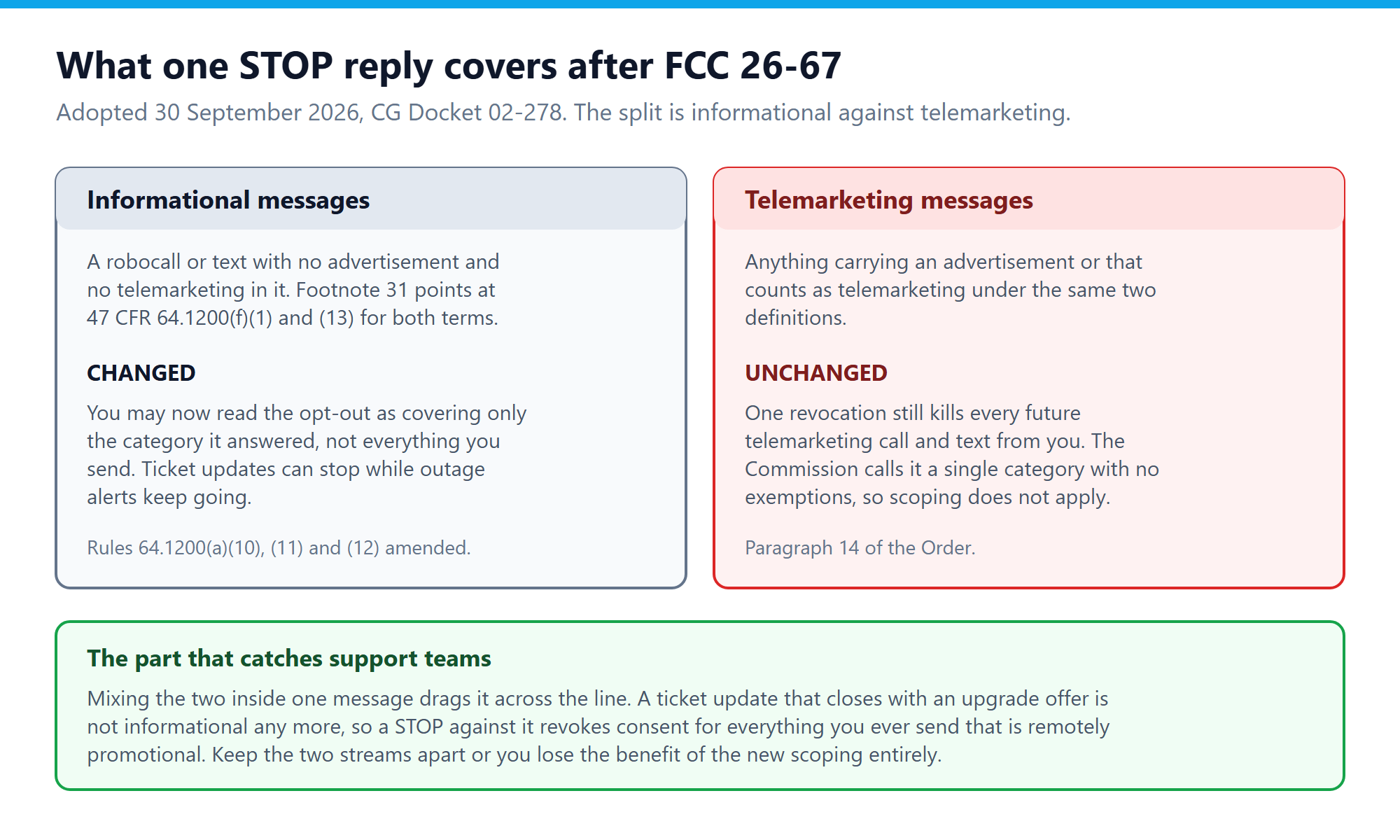
Read that split carefully, because the damage runs one way. Mixing a promotional line into an otherwise informational message pulls the whole thing across to the telemarketing side. A ticket-resolved notification that ends with an upgrade offer is not informational any more, and a STOP against it takes your promotional consent with it.
Why most help desks cannot use this yet
Here is the honest problem. The rule lets you scope an opt-out to a category. Most support platforms do not have categories. They have a notifications toggle, on or off, one per contact.
If that is your setup, nothing improves. A customer replies STOP, you have no category to attribute it to, and the only safe reading is that they opted out of everything. You get the compliance obligation without the flexibility.
So the work is not legal work. It is schema work, and it needs doing before the effective date rather than after.
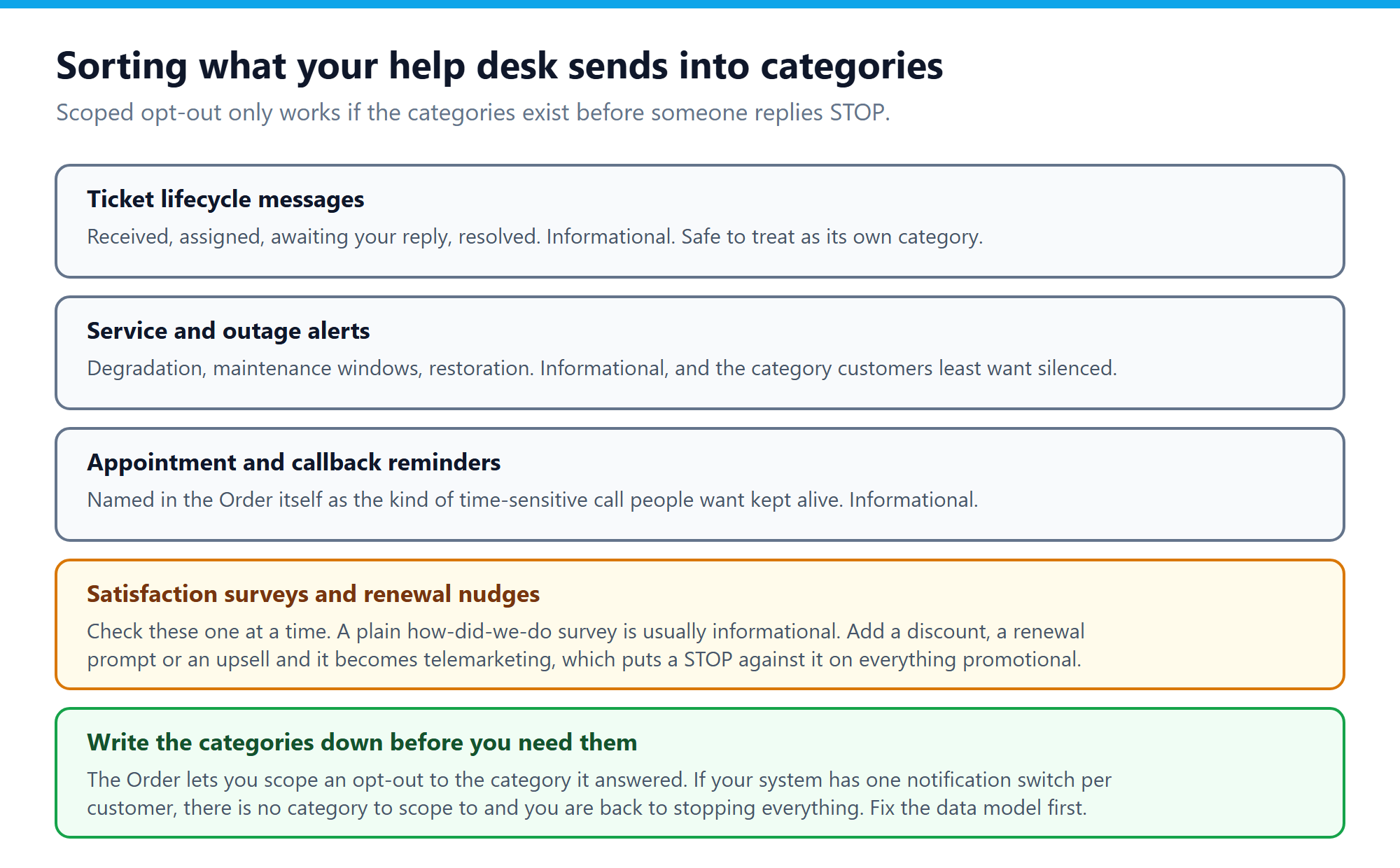
Ticket lifecycle messages are straightforward. Received, assigned, waiting on you, resolved. Service and outage alerts are their own category, and they are the one customers are angriest about losing by accident. Appointment and callback reminders get named in the Order itself as the sort of time-sensitive message people actually want kept alive.
Surveys are where I would slow down. A plain how-did-we-do survey normally reads as informational. Attach a renewal prompt or a discount code and you have written a telemarketing message, with the broader opt-out that comes with it. Check them one at a time rather than classifying the whole survey queue in one go.
When this takes effect
Section E, paragraph 24: the revised amendments become effective 30 days after Federal Register publication. At that point the change to 64.1200(a)(10) supersedes the delayed effective date that had been pushed out to 31 January 2027.
That last part is worth saying plainly, because a lot of teams have been planning around January 2027. That date is going away earlier than expected. One party asked the Commission for up to 12 months after publication and the FCC declined, specifically so callers could start using the modernised consent methods sooner.
Publication has not happened as I write this, so nobody can give you a hard date yet. What you can do is stop treating January 2027 as your deadline.
What has not changed
Paragraph 19 keeps the existing opt-out mechanics in place for exempted calls and for anything carrying an advertisement. Section 64.1200(b)(3) still requires an automated, interactive voice or key-press opt-out on those. If you built that, keep it.
The Further Notice also leaves several questions open: whether to shorten the time allowed to honour a revocation, whether to require two-way texting, whether to mandate a revoke-all option, and how affiliates should be treated. Those came from a joint filing by the American Bankers Association, the National Consumer Law Center and ACA International. Comments are due 30 days after publication, replies at 60.
I would not build anything that depends on those staying open.
What to do this month
Start by listing every automated message your desk sends and marking each one informational or telemarketing against the two definitions. Most teams find at least one message they assumed was informational that is not.
Then check whether your platform can record which category an opt-out answered, not just that one happened. If it cannot, that is the gap to close. The same discipline applies to anything your automation sends on its own, which is the point we made about proving what your AI agent did to a ticket: the record has to carry enough detail to reconstruct the decision later.
And keep the streams separate. The temptation to append a small offer to a well-read service notification is exactly what costs you the scoping benefit. A German court made a related point about being bound by what your support bot says, and the principle carries: the operator owns the message, whatever system generated it.
FAQ
Does this mean customers can no longer stop all our messages at once?
No. They can still revoke consent for everything, and for telemarketing a single request still covers all of it. What changed is that an opt-out aimed at one category of informational message no longer has to be read as covering every other category.
Is a password reset or MFA code covered by this?
Those are informational if they carry no advertisement. Whether they are robocalls at all depends on how they are sent, since the Order defines a robocall as a call or text sent using an automatic telephone dialing system or an artificial or prerecorded voice. Worth checking with counsel for your specific sending path.
Do we have to adopt category-scoped opt-outs?
No. The rule permits the narrower reading, it does not require it. Treating every opt-out as covering everything stays compliant and is simpler. It just annoys customers who wanted to keep their outage alerts.
What if a customer replies STOP to a message that was both informational and promotional?
Then you are on the telemarketing side and the broad revocation applies. This is the strongest practical argument for keeping the two message types in separate sends.
When exactly does this start?
Thirty days after the Order appears in the Federal Register. That had not happened at the time of writing, so there is no fixed date yet. Watch for publication rather than waiting for January 2027.
Does this change anything about who we can message in the first place?
Nothing in this Order loosens consent capture. It governs revocation, not acquisition. How you obtained the number and what the person agreed to still carries the same weight it always did.
Source: Federal Communications Commission, FCC 26-67, Report and Order and Further Notice of Proposed Rulemaking, CG Docket No. 02-278, adopted 30 September 2026, released 1 October 2026.