
Zendesk’s July 2026 release notes dropped this week, and they’re substantial: Forethought AI agents arrive as a purchasable add-on, a native contact center goes GA, and workforce management becomes free on Suite Professional plans. Good news for feature lists. Mixed news for budgets, since the headline items live behind add-ons and higher tiers.
If you run a support team, this release is worth ten minutes of your attention whether you use Zendesk or not. It shows exactly where the help desk market is heading, and what that direction costs.
The Big Six Changes
1. Forethought AI agents, sold as an add-on
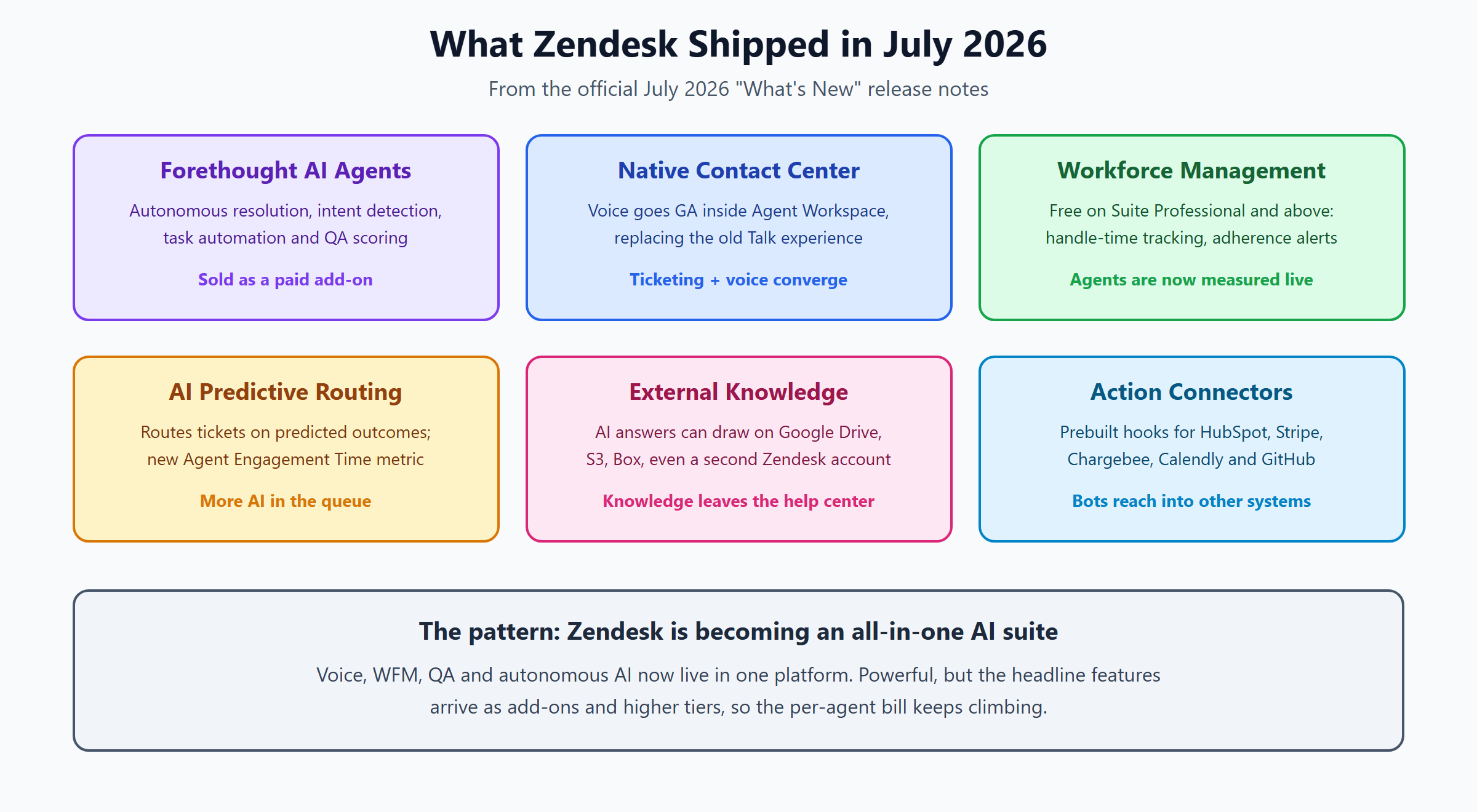
The most significant item. Zendesk closed its Forethought acquisition and the technology is now purchasable directly: autonomous ticket resolution, intent identification, task automation, and AI-driven QA scoring. This is a real capability jump. It’s also a separate line on the invoice, on top of your Suite subscription and on top of Zendesk’s existing per-resolution AI pricing.
2. A native contact center
Zendesk Contact Center is now generally available inside Agent Workspace, replacing the bolted-on Talk experience. Voice, chat, and tickets finally share one screen. Anyone who has toggled between a phone system and a ticket queue knows why this matters, and it’s the same reason we built ICTDesk to sit beside existing telephony rather than apart from it.
3. Workforce management goes free
WFM is now included on Suite Professional and above: average-handle-time tracking and real-time out-of-adherence alerts that flag agents the moment their activity drifts from schedule. Team leads will love the visibility. Agents will notice they’re now measured minute by minute. If you switch these alerts on, tell your team first. Surveillance that arrives unannounced burns trust you won’t easily get back.
4. AI predictive routing
Tickets can now route on predicted outcomes rather than simple round-robin, and a new Agent Engagement Time metric measures actual working time on each ticket. More signal for managers, more AI in the queue.
5. Knowledge escapes the help center
AI answers can now draw on external sources: Google Drive, Amazon S3, Box, even a second Zendesk account. Your bot is no longer limited to articles someone remembered to publish. The flip side: your bot can now surface anything in those folders, so review what you connect before you connect it.
6. Action connectors and housekeeping
Prebuilt action connectors for HubSpot, Chargebee, Stripe, Calendly, and GitHub let bots act in other systems, not just answer questions. Smaller items round it out: end-user presence detection, plain-language descriptions in AI access logs, and the ability to pause an account for up to three months.
The Pattern Behind the Release
Step back from the individual features and one theme emerges: consolidation. Voice, WFM, QA, autonomous AI, and external actions now all live inside one platform. Zendesk is no longer selling help desk ticketing software. It’s selling an AI operations suite, priced accordingly.
That’s a fine strategy, and for large enterprises it may genuinely simplify things. But notice the mechanics. The base subscription gets you the platform. The capabilities everyone actually wants this year, autonomous AI resolution above all, arrive as add-ons with their own meters. Per agent, per resolution, per month, the bill compounds.
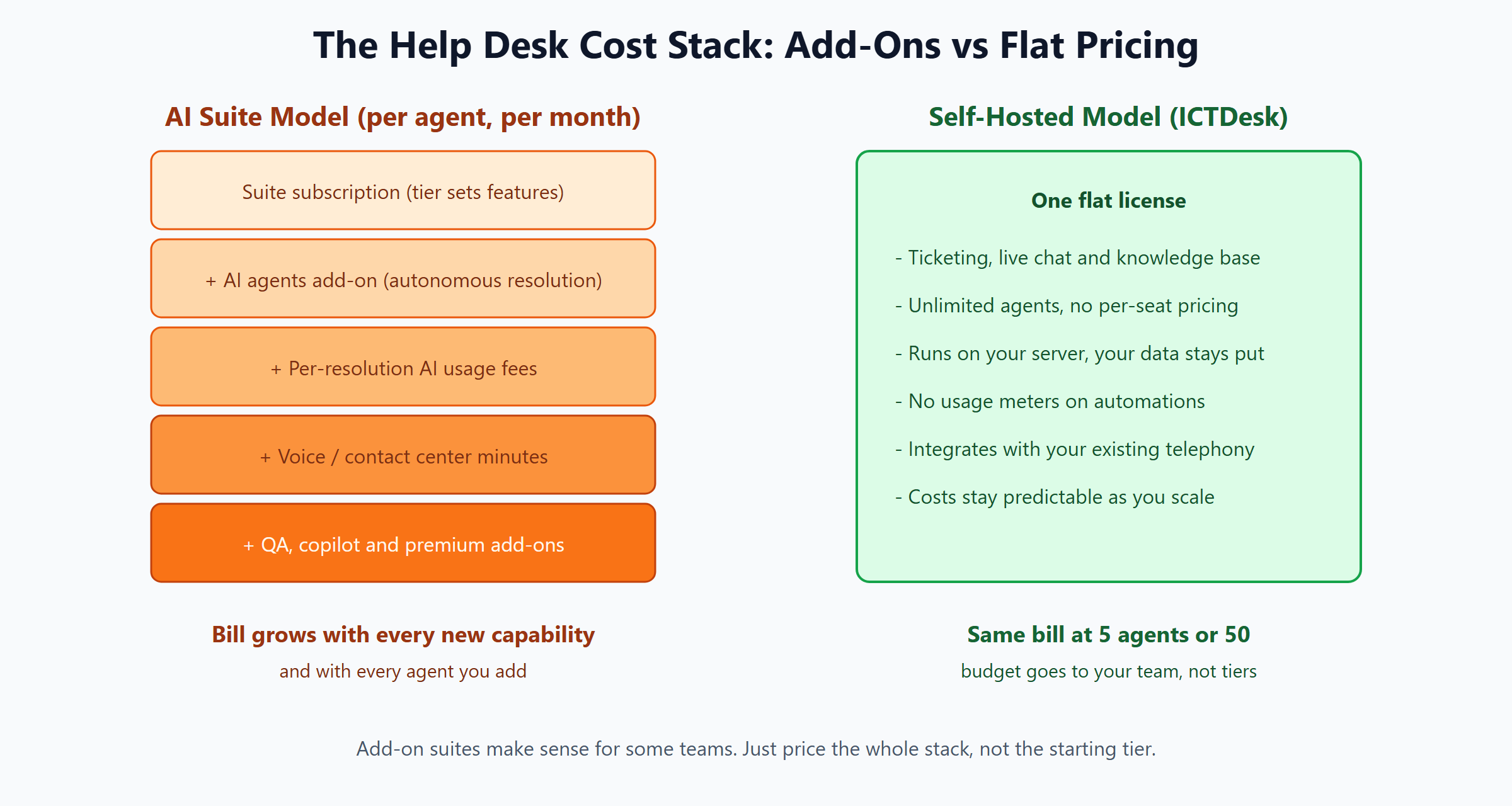
We wrote about this dynamic at length in our Zendesk alternative comparison, and this release strengthens the argument rather than weakening it. Growing teams hit a point where per-seat, per-feature pricing punishes growth itself. Hiring three support agents shouldn’t trigger a procurement review.
What This Means If You’re Choosing a Help Desk
Three practical takeaways from this release cycle.
Price the stack, not the tier. When you compare platforms, model your real configuration: base plan, AI add-on, expected AI resolutions, voice minutes. The sticker price on the pricing page is the floor, not the estimate.
Ask where AI features actually run. Autonomous agents reading tickets and acting in Stripe or GitHub are powerful, and they concentrate risk. Just this week, researchers disclosed a flaw in Google’s Dialogflow platform that let one code snippet read every AI agent conversation in a project. Connected AI needs the same scrutiny as any production system.
Decide what you’d pay for control. A self-hosted help desk like ICTDesk won’t hand you a Forethought-grade autonomous agent out of the box. What it hands you instead: your ticket data on your own server, unlimited agents on flat pricing, and automations without usage meters. We covered how AI triage and routing work in that model in our guide to agentic AI help desks in 2026.
Honestly, both models can be the right answer. A 500-agent enterprise with a Zendesk admin team will absorb the add-on stack without blinking. A 12-person support team watching every invoice line usually can’t, and shouldn’t have to.
FAQ
What’s new in Zendesk’s July 2026 release?
The headline items: Forethought AI agents as a purchasable add-on (autonomous resolution, intent detection, task automation, QA), Zendesk Contact Center generally available in Agent Workspace, free workforce management on Suite Professional and above, AI predictive routing, external knowledge sources for AI answers, and prebuilt action connectors for HubSpot, Stripe, Chargebee, Calendly, and GitHub.
Is the Forethought AI agent included in Zendesk Suite plans?
No. It’s a separate purchasable add-on on top of the Suite subscription, and Zendesk’s AI usage is metered, so expect per-resolution costs alongside the add-on fee.
What is out-of-adherence alerting in Zendesk WFM?
A real-time alert that flags agents whose current activity doesn’t match their scheduled task, visible to team leads the moment it happens. It ships free with WFM on Suite Professional and above.
Does this release change what Zendesk costs?
The base tiers are unchanged, but the release deepens the add-on model: the most valuable new capability (autonomous AI) is priced separately. Teams should model total cost with add-ons and AI usage, not just the per-seat tier price.
How does ICTDesk compare with the new Zendesk?
ICTDesk is self-hosted live support and help desk ticketing software with flat licensing: unlimited agents, ticketing, live chat, and knowledge base on your own server, with no per-resolution AI meters. It suits teams that want predictable costs and full data control; Zendesk’s new suite suits enterprises that want maximum out-of-the-box AI and will pay per capability.
Should existing Zendesk customers act on this release?
Yes, on two fronts: review what the AI agents add-on would cost at your ticket volume before sales does the math for you, and if you enable WFM adherence alerts, communicate it to your team first and review what external knowledge sources your AI can now read.